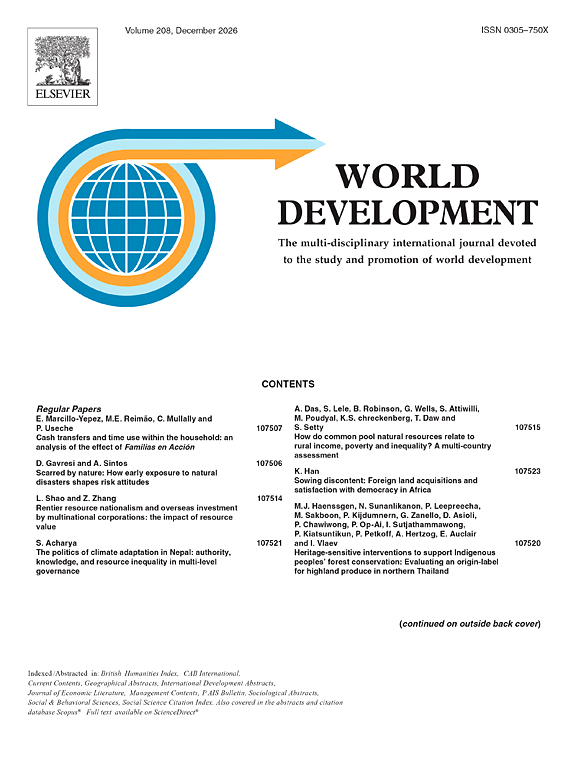
The World Development jounal has just published my latest study on the global convergence of realized and produced exploitation rates. The paper is published open acces until 18 November 2026 via this link:
Rotta, T. N. (2026) Measuring Global Exploitation, 1990–2023: Does Globalization Equalize Exploitation Rates? World Development (forthcoming). [Appendix]
The link to the open access version of the paper will be available until 18 November 2026 only. After that you will need a subscription to read it. If you do not have an Elsevier subscription, you can read the full paper via this link, which includes the appendix but does not have Elsevier’s formatting and typesetting.
The panel datasets introduced in the study are made publicly available via the Zenodo repository:
Rotta, T. N. (2026) Panel Data of Global Exploitation Rates (1990-2023): CSV and Parquet Files [Data set]. Zenodo.
.
Highlights
- The paper presents the most comprehensive empirical analysis of labor exploitation and unequal exchange of labor to date.
- New panel dataset covers 120 sectors across 164 countries from 1990 to 2023.
- Novel method to estimate value-added as produced, realized, and captured in global value chains.
- Finds global convergence in exploitation rates across both complex and simple forms of labor.
- Reveals persistent core–periphery hierarchies in exploitation and value transfers across countries and industries.
Abstract
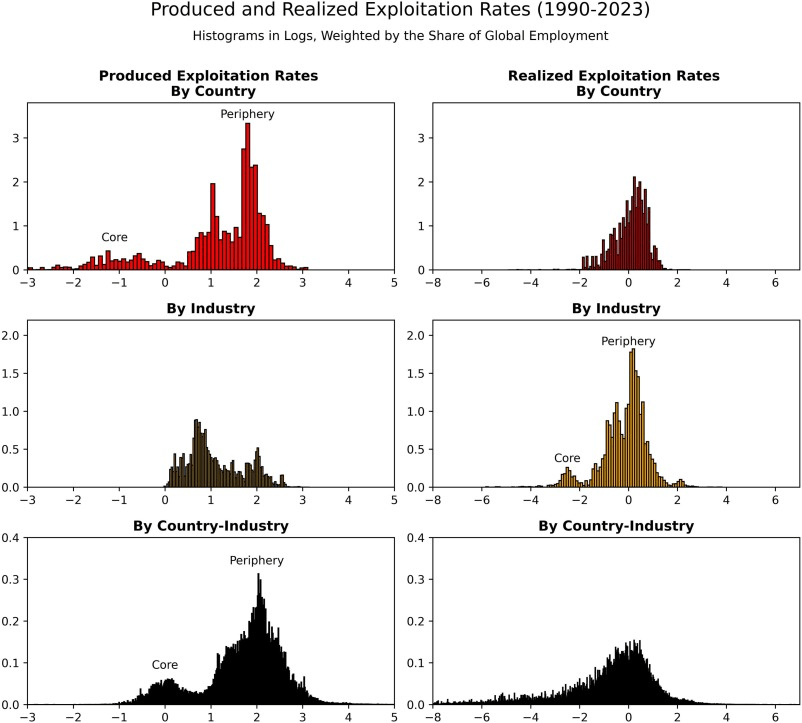
This paper develops a novel empirical framework to estimate exploitation rates (the ratios of unpaid to paid labor time) and tests the hypothesis that globalization fosters their convergence. By integrating the Leontief input–output model with the New Interpretation of Marxian value theory, the analysis distinguishes between value production and value realization, exploring their distinct implications for global exploitation. Drawing on the GLORIA dataset, comprising 1.2 terabytes of input–output data covering 120 sectors across 164 regions from 1990 to 2023, this study offers the most comprehensive empirical investigation of exploitation rates to date. The analysis spans four levels of aggregation (global, national, sectoral, and country–sectoral) and incorporates alternative classifications of productive and unproductive activities. A key methodological innovation is the comparative estimation of exploitation rates before and after the cross-border and cross-sectoral reallocation of value-added. The findings reveal a global fall in exploitation rates accompanied by absolute convergence. Yet this coexists with relative divergence, sustaining a core–periphery structure within global value chains. While most value is produced in peripheral regions, value realization is concentrated in the core. Unequal exchange, manifested through value transfers from high- to low-exploitation activities, conceals the global hierarchy of labor. By focusing solely on realized value, the System of National Accounts obscures these transfers, attributing peripheral value creation to core economies. The data further highlight the growing relevance of the core–periphery divide across industries. The paper reflects on the implications of these dynamics for theories of uneven development.
.
.
Let me know what you think if you happen to read the full paper.
Comments are welcome, even if you are critical of the approach and results!
.
.
.
.

