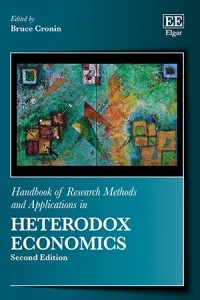
I am pleased to share the publication of my latest book chapter in the second edition of the Handbook of Research Methods and Applications in Heterodox Economics, edited by Professor Bruce Cronin of the University of Greenwich, London, UK.
This new edition brings together 31 chapters across 678 pages, offering a wide-ranging collection of research methods, theoretical perspectives, and empirical applications in heterodox economics.
As described in the handbook’s abstract:
“This updated second edition provides a comprehensive guide for conducting rigorous, socially grounded contemporary economic research outside the confines of current orthodox methods. The Handbook builds on the original framework of critical realism and grounded theory established in the first edition, with new perspectives and tools”.
I contributed a chapter that develops a methodology for empirically estimating Marxian economic categories using global input–output data. The approach integrates Leontief’s input–output framework with the New Interpretation of Marx’s value theory, providing researchers with a systematic method for analysing the production, realization, and transfer of economic value across industries, countries, and the global economy.
The chapter includes a step-by-step methodological exposition, beginning with a simplified three-sector economy before extending the analysis to real-world, multi-regional input–output data.
The full bibliographic reference and link to my chapter are provided below:
Rotta, T. N. (2026) Estimating Marxian Economic Categories: A Global Input-Output Approach Integrating Leontief and the New Interpretation. In B. Cronin (ed.), Handbook of Research Methods and Applications in Heterodox Economics, 2nd edition, pp. 375–402.
Chapter abstract
This chapter introduces a novel methodology for estimating Marxian economic categories using multi-regional input–output data. The approach integrates the Leontief input–output model with the New Interpretation of Marx’s value theory, offering a comprehensive framework for analysing the production, realization, and transfer of economic value across national, regional, and global scales. The chapter provides a detailed, step-by-step guide that combines theoretical insights with practical, data-driven applications. By utilizing publicly available datasets, including the World input–output Database (WIOD), this methodology enables the estimation of key Marxian variables, such as exploitation and profit rates, at the country-industry level. The methodology is demonstrated through a simplified three-sector model before being extended to global-scale data. Ultimately, this chapter reaffirms the relevance of Marxian value theory in contemporary economic analysis and provides researchers with powerful tools to explore and understand the dynamics of the global economy.
.
.
.
.

