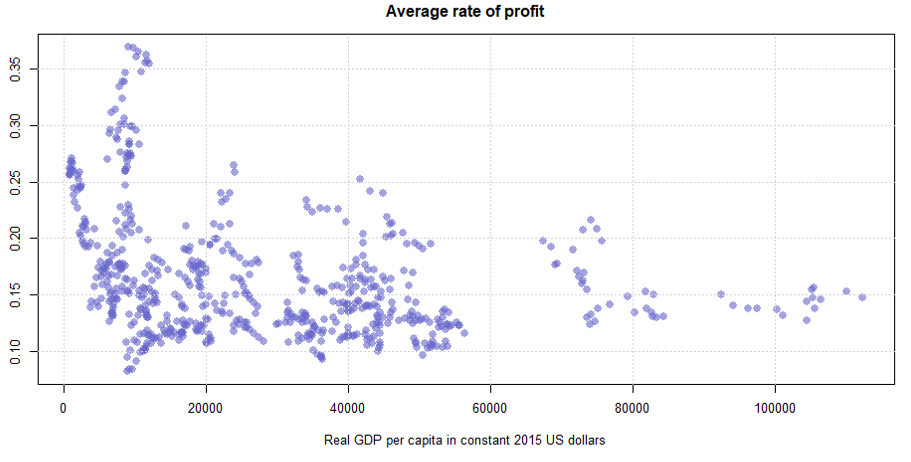
I presented the first draft of my new paper co-authored with Rishabh Kumar (UMass Boston) at the annual conference of the Association of Heterodox Economics (AHE) on July 8th 2022, which took place at SOAS in London. The current working title of our paper is “Was Marx Right? Evidence from 43 Countries, 2000-2014“. One of the interesting things that we accomplish in this paper is that we estimate “Kuznets curves” for Marxist variables across 43 countries using input-output matrices, such as the figure above in which we plot the average profit rate against real GDP per capita in dollars. We estimate how Marxist variables relate to the countries’ development levels. In total, we estimate 217 Marxist variables for the global economy.
We create a software that fully automates the implementation of our methodology using data from the Word Input-Output Database (WIOD). The most difficult step was to classify into productive and unproductive activities the 57 industries in each of the 43 countries for each year between 2000 and 2014. We convert into productive and unproductive activities not only the socio-economic accounts but, most importantly, the entire global input-output matrices, including the gross output, value added, and intermediate inputs entries across countries.
The slides of my presentation are available here. Let me know what you think if you happen to read the slides. Rishabh and I are still working on the paper, so there is no full draft yet. The draft abstract is as follows:
The paper analyses structural transformations in the global economy from a Marxist perspective. It develops a new methodology and a software to compute 217 Marxist variables at the global level for a set of 43 developed and developing countries using multi-country input-output data from 2000 to 2014. Our methodology and software deliver a comprehensive dataset in panel format. The paper provides estimates of a wide range of Marxist variables at the global level, both within and across countries, including profit rates, exploitation rates, knowledge rents, and the composition of capital. The panel dataset also includes the shares of each country in the global aggregates, as well as comprehensive estimates of income flows and stocks of fixed assets in productive and unproductive activity. We find that Marx’s assertions concerning technology and power are valid at the global level: labour-saving capital-intensive technical change reduces profitability despite the rise in the rate of exploitation. Exploitation rates, profit rates, and the organic composition of capital vary inversely with development levels. Unproductive activity and knowledge rents, on the contrary, increase with the level of development. Productive activity has moved rapidly towards China and away from the rest of the world economy, while the United States have had by far the highest global shares of unproductive activity and of knowledge rents.
Key words: global economy, Marxist theory, Classic framework, productive and unproductive activities; panel data
.
.
 Tomas Rotta
Hi Tomas, this is fantastic. Did you ever release the program/methodology ‘R code and the Excel file‘? I checked your GitHub and couldn’t find anything. Best regards.
Dear Joe, the panel datasets which I created for this paper are already available here:
Was Marx right? Development and exploitation in 43 countries, 2000–2014 – ScienceDirect
And here:
Panel Dataset of Marxist Variables at the Global Level (2000-2014)
I have not yet posted the full R code on my GitHub page, but I will do it asap.
Best regards,
Tomas Rotta