I am currently working on a research project titled “Measuring Global Exploitation, 1990–2021: Does Globalisation Equalise Exploitation Rates?”. Below you can find a link to the presentation slides from the latest version of this work, which I presented at the Association for Heterodox Economics (AHE) Conference at King’s College London in June of 2025:
Rotta, T. (2025) Measuring Global Exploitation, 1990-2021: Does Globalisation Equalise Exploitation Rates? Association for Heterodox Economics (AHE) conference at King’s College London, June 2025.
For this research project, I have created panel datasets of produced and realized exploitation rates at the global, country, industry, and country-industry levels of aggregation. These datasets are publicly available in Parquet and CSV formats:
Rotta, T. (2025) Panel Data of Global Exploitation Rates (1990-2021): CSV and Parquet Files [dataset]. Zenodo repository.
Abstract:
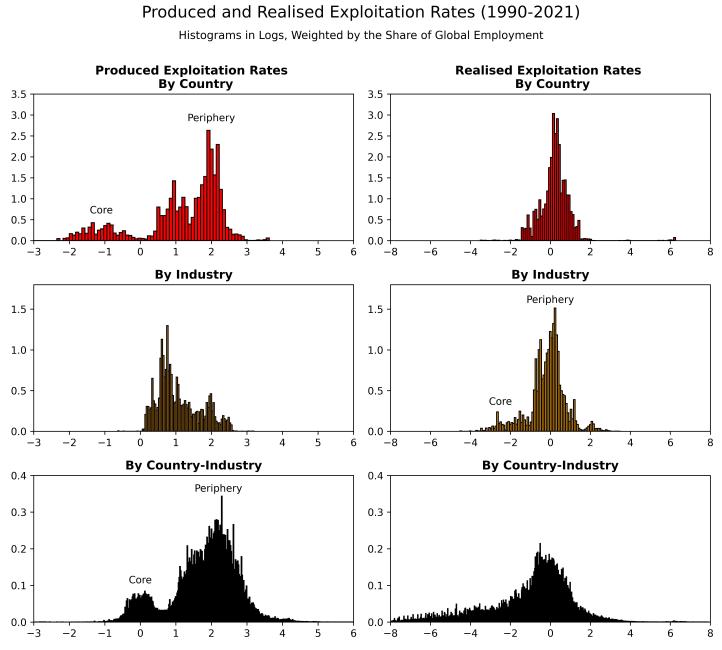
This paper develops a novel empirical framework to estimate exploitation rates (the ratios of unpaid to paid labour time) and tests the hypothesis that globalisation fosters their convergence. By integrating the Leontief input–output model with the New Interpretation of Marxian value theory, the analysis distinguishes between value production and value realisation, exploring their distinct implications for global exploitation. Drawing on the GLORIA dataset, comprising one terabyte of input–output data covering 120 sectors across 164 regions from 1990 to 2021, this study offers the most comprehensive empirical investigation of exploitation rates to date. The analysis spans four levels of aggregation (global, national, sectoral, and country–sectoral) and incorporates alternative classifications of productive and unproductive activities. A key methodological innovation is the comparative estimation of exploitation rates before and after the cross-border and cross-sectoral reallocation of value-added. The findings reveal a global rise in exploitation rates accompanied by absolute convergence. Yet this coexists with relative divergence, sustaining a core–periphery structure within global value chains. While most value is produced in peripheral regions, value realisation is concentrated in the core. Unequal exchange, manifested through value transfers from high- to low-exploitation activities, conceals the global hierarchy of labour. By focusing solely on realised value, the System of National Accounts obscures these transfers, attributing peripheral value creation to core economies. The data further highlight the growing relevance of the core–periphery divide across industries. The paper reflects on the implications of these dynamics for theories of uneven development and the political economy of globalisation.
Keywords: Globalisation, exploitation, Marxian economics, value theory, input–output analysis
JEL Classification: C67 (Input–Output Models), B51 (Socialist; Marxist; Sraffian), F62 (Macroeconomic Impacts of Globalization)
.
.
Let me know what you think. Feedback is welcome. I would be very interested to hear your thoughts on the methods, findings, or implications of this work.
The paper is currently under review and I am unable to share the full manuscript.
.
.
.
 Tomas Rotta