.
The journal Environment and Planning A: Economy and Space has just published (open access) my most recent study on the production and capture of economic value on a global scale.
The paper title is “Value Capture and Value Production in the World Economy: A Marxian Analysis of Global Value Chains, 2000-2014“.
The full paper is available in HTML and PDF. The online appendix is available here.
.
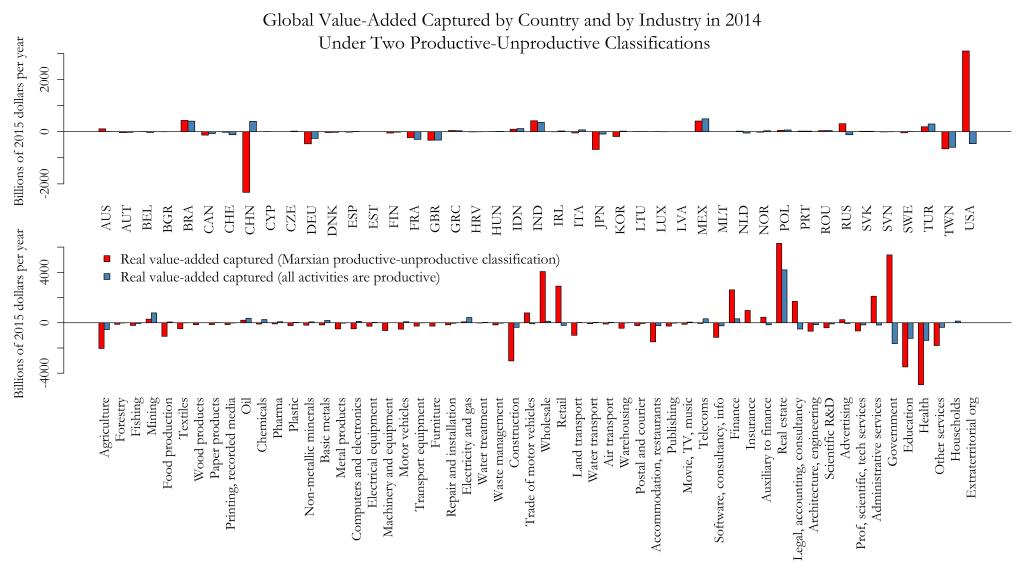
The paper estimates the production, realisation, and capture of economic value in the world economy from 2000 to 2014. Estimates show how value is produced and transferred across 56 sectors and 43 countries. The methodology builds on the Marxian literature and the productive-unproductive classification. Value production is the labour directly and indirectly required to produce goods and services within global value chains. Value capture is the deviation between value realisation and production. Results show that China is the largest giver of value while the USA is the largest capturer of value in the world economy. Unproductive activities (real estate, finance, and trade) and capital-intensive industries (manufacturing, mining, and oil) are value capturers. Labour-intensive industries (health, education, construction, agriculture, and services) transfer value away. The paper also demonstrates that the theory of unequal exchange is incompatible with the conventional assumption that all activities are productive. Only under the Marxian productive-unproductive classification do the results converge with unequal exchange theory.
.
This is the complete reference:
Rotta, T. (2025) Value Capture and Value Production in the World Economy: A Marxian Analysis of Global Value Chains, 2000-2014. Environment and Planning A: Economy and Space. OnlineFirst. [PDF] [online appendix]
There has been some coverage of this paper on the internet: in Portuguese here and here, and in German here.
Let me know your comments if you happen to read the paper, even if you are critical of the approach.
.
.
.
.
 Tomas Rotta
[…] that nonproduction value capture in their input-output tables is probably underestimated. Indeed, other work on this by Thomas Rotta, incorporating production and non production sectors, finds that China is the largest giver of […]
[…] valor no productivo en sus tablas de input-output probablemente esté subestimada. De hecho, otro trabajo sobre esto de Thomas Rotta, que incorpora los sectores de producción y no producción, encuentra que China es el […]