
My paper with Rishabh Kumar on the relevance of Marx today just got published in the journal Structural Change and Economic Dynamics (SCED). The paper and the supplementary material including our new panel dataset of Marxist variables are available open access. Read my tweet about the paper.
Abstract
We assess Marx’s hypotheses about capitalist development on a global scale by constructing a new dataset of Marxist variables (profit rates, exploitation rates, composition of capital, and shares of productive activity) for 43 major economies, derived from world input-output data and national accounts in the 2000–2014 period. Consistent with Marx’s hypotheses, the average profit rate declines at the world level, between countries, and within countries. The global rate of exploitation increases until 2008 but stagnates after the financial crisis, while capital intensity continued to increase. At the cross-country level, rich countries became increasingly dominated by unproductive activity. China absorbed much of the world’s productive activity and kept the labor share of value added roughly constant at the world level.
Rotta, T. and Kumar, R. (2024) Was Marx Right? Development and Exploitation in 43 Countries, 2000-2014. Structural Change and Economic Dynamics 69, pp.213-223 [open access] [PDF]
.
Click here to read my latest presentation slides on this paper.
Click here to read the presentation slides which include estimates across different classifications of productive and unproductive activities.
Click here to watch my webinar on YouTube about the paper, in Portuguese.
.
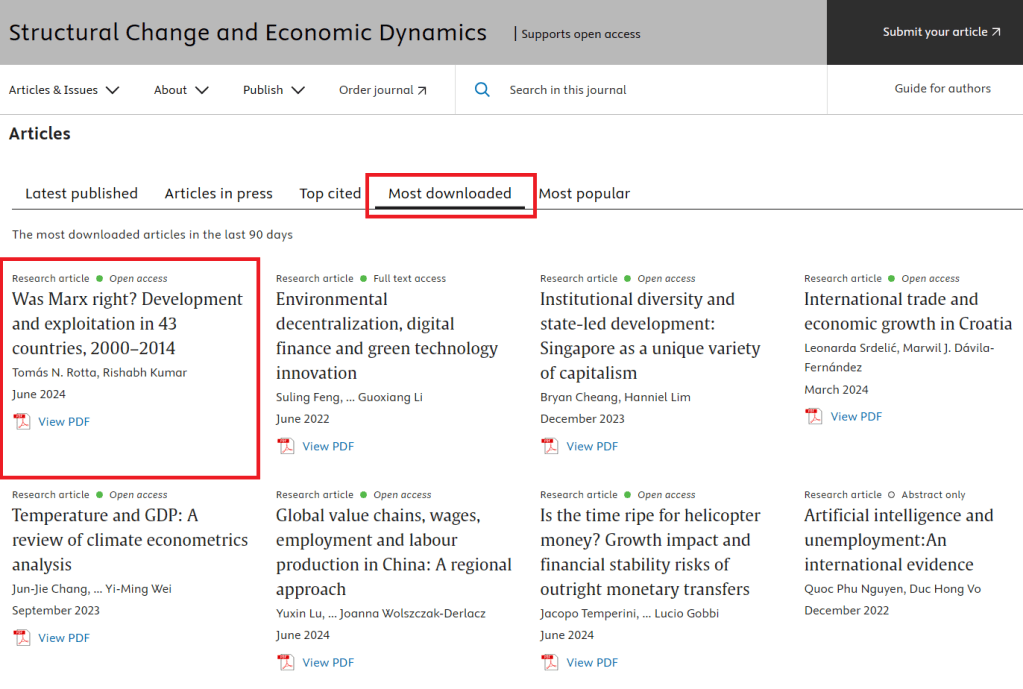
The paper was ranked #1 in the “most downloaded” list in the SCED journal in the first three months of 2024. See here and here.
.
As of 6th January 2025, the paper is ranked #1 in terms of popularity, defined as “articles from the last 3 years that have received the most social media attention”:

.
There has also been some media attention about this paper:
.
.
.
.
 Tomas Rotta