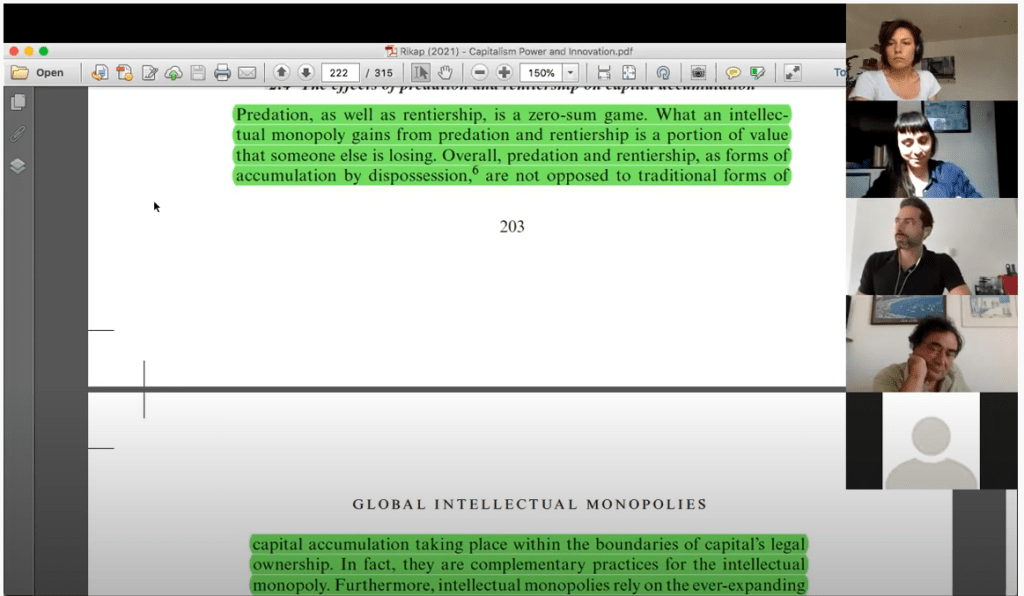
Cecilia Rikap organized the launch of her new book Capitalism, Power and Innovation: Intellectual Monopoly Capitalism Uncovered, now published by Routledge, as an online session in the last IIPPE conference on 12 September 2021, which was held online.
The book launch started off with a summary by Cecilia Rikap herself and was then followed by comments from Benjamin Selwyn, Ugo Pagano, myself, and was moderated by Hannah Bensussan. The recording of the event is available on YouTube.
My comments about Cecilia’s book were mostly on issues of value theory and the dynamic effects between information rents, value added creation, and distribution. My main argument was that the impacts of information rents on growth and distribution must be decomposed into the direct and indirect effects, with particular emphasis on the distinction between the short- and long-run horizons. It is possible, I claimed, that the negative short-run direct effects are overcome by the positive long-run indirect effects. Despite directly drawing from the aggregate pool of value added in the global economy, information rents might give rise to larger positive indirect effects by enhancing labor productivity or by boosting investment and aggregate demand in activities that directly produce value added. This is what I claim in my recent working paper Information Rents, Economic Growth, and Inequality: An Empirical Study of the United States. The issue of whether or not the net effects (direct plus indirect) of information rents on growth and distribution are positive or negative is an empirical matter and cannot be stablished solely at the theoretical level.
Cecilia Rikap’s new book is a great contribution to the Political Economy scholarship on the monopolization of knowledge and intellectual property rights. Highlights of her book include an extensive bibliographical research and a super interesting network analysis of knowledge transfers between governments, universities, state companies, and private conglomerates. The evidence from her network analysis is that knowledge and the profits associated with it are becoming ever more concentrated at a few super-corporations with greater monopoly power on output markets and greater monopsony power on input markets.
.
.
 Tomas Rotta